Why Do Some Colored Contacts Feel Like Nothing? The Secret to Ultra-Comfortable Lenses
Jun 30,2026 | EYEVOS
Why Do Some Colored Contacts Feel Like Nothing? The Secret to Ultra-Comfortable Lenses
When people describe the colored contacts they love, they almost always reach for the same sentence:
"I forgot I'm wearing them."
It isn't a marketing line. It's what your eyes naturally say back to you when a lens has been designed correctly.
But that weightless feeling doesn't come from a single magic spec. It needs five details to line up at once — how the pigment is sealed, how the lens breathes, how its water content is balanced, whether its measurements fit your eye, and whether your solution gets along with your tear film. Miss one, and comfort quietly collapses within a few hours.
This article walks through all five.
Discomfort Is More Common Than You'd Think
Before writing this, we dug into the clinical data — and what we found surprised us. According to the American Academy of Ophthalmology (AAO), more than half of all contact lens wearers experience dryness, foreign-body sensation, or visual fatigue at some point. Discomfort is the single biggest reason people quit contacts altogether.
In other words: "comfortable" sounds like a baseline expectation, but it's actually a high bar to clear. For colored lenses, the bar is even higher — there's an extra layer of pigment work, and any shortcut taken during manufacturing will have your eyes reporting back honestly.
Secret 1: Where the Pigment Sits Decides What Your Eyelids Touch
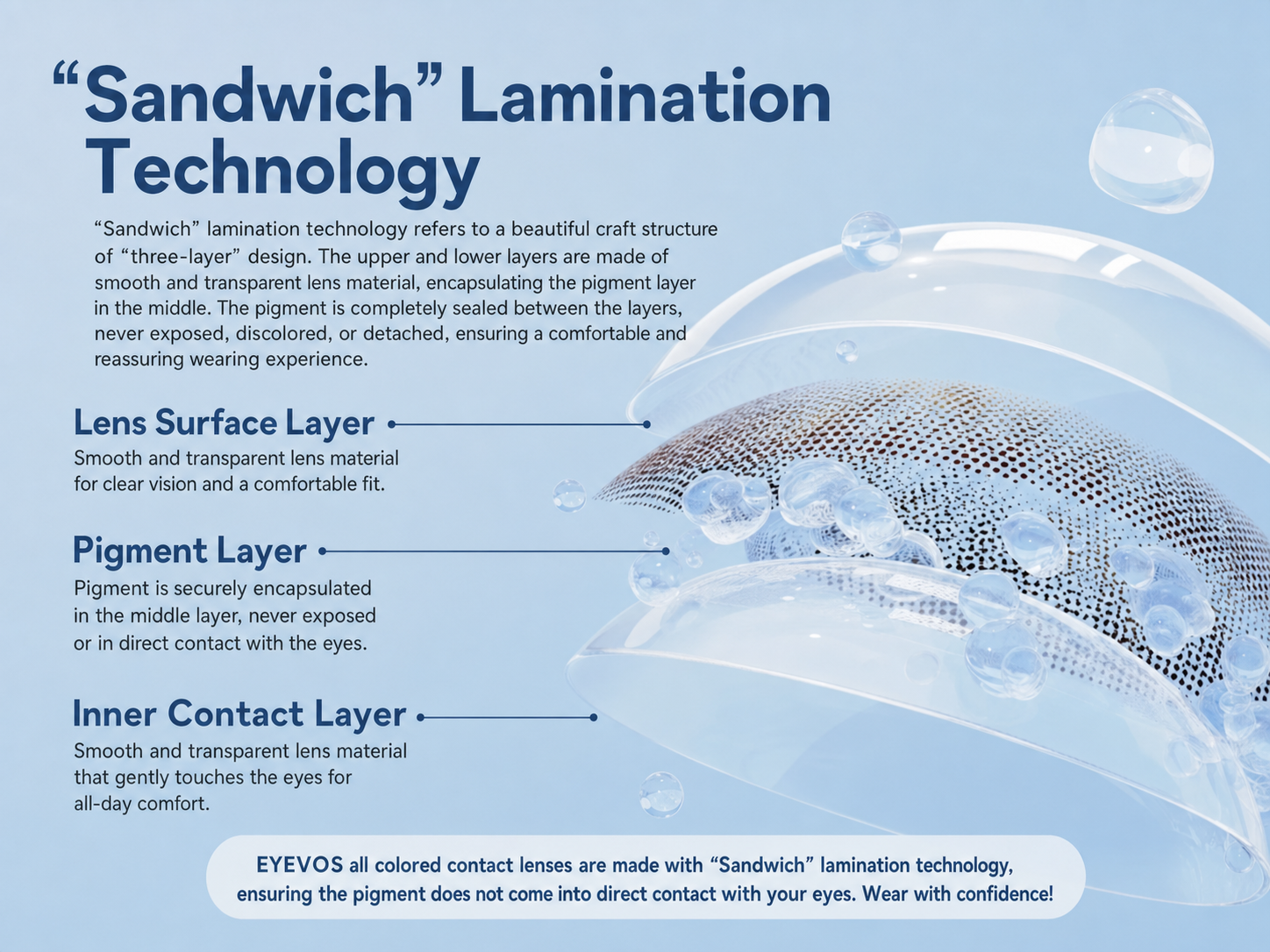
In the most comfortable colored lenses, the pigment is locked entirely inside the lens.
The industry calls this Sandwich Technology — the pigment layer is fully enclosed between two transparent layers of lens material. Between your eyelid and the pigment, there's always a smooth, clear barrier. Cheaper colored lenses often use Surface Printing, where the pigment is printed directly onto one face of the lens.
Why does this matter so much?
The U.S. Food and Drug Administration (FDA) classifies all decorative contact lenses — including zero-power cosmetic ones — as Class II medical devices, and explicitly warns that pigment adhering directly to the lens surface poses dual risks: chemical migration and mechanical abrasion of the corneal epithelium.
Adults blink 15–20 times per minute. Across a full day, that's tens of thousands of micro-frictions between your eyelid and the lens. When the pigment is exposed, every single blink drags your eyelid across uneven pigment granules.
This is what people are describing when they say things like:
"TTDEYE lenses made my eyes burn."
"I tried moody and olens, and they kinda feel like they're scratching at my eye."
"Ang bilis niyang maging uncomfy sa eyes, pati natutuyo agad."
That familiar "fine in the morning, scratchy by afternoon" experience? It often traces back to this single manufacturing gap.
How to check yours. Hold the lens up to the light. Sandwich-encapsulated lenses are equally smooth on both sides, with the color appearing to float in the middle. Surface-printed lenses show a slightly raised ring on one side when backlit — sometimes you can even feel the edge with a clean fingertip.
Secret 2: Lenses Need to Breathe — But "Breathing" Isn't Just About the Material
Your cornea has no blood vessels. Every molecule of oxygen it gets has to pass through the air, your tear film, and — when you wear contacts — your lens.
The spec that measures this is Dk/t (oxygen transmissibility). The internationally accepted clinical safety floor for daily wear is Dk/t ≥ 24 ×10⁻⁹, a benchmark established by Holden and Mertz in their 1984 Investigative Ophthalmology & Visual Science paper. It's still the global reference today.
But here's what most people miss: Dk/t isn't determined by the material name alone. It's the product of material × water content × lens thickness.
Which means:
- A classic hydrogel base, when paired with optimized water content and refined thickness engineering, can absolutely meet the daily-wear oxygen threshold;
- A silicone polymer base, if poorly engineered or weighed down by heavy surface pigment, can have its oxygen flow dragged down significantly;
- What actually determines your comfort isn't the material word printed on the box — it's whether this specific lens has been designed for your wear pattern.
Two compliant hydrogel families dominate the global market, each having its own strengths:
|
Material Type |
Best Suited For |
Key Characteristic |
|
Classic Hydrogel |
Everyday 6–8 hour wear, sensitive eyes, first-time users |
Soft, skin-friendly, weightless feel — built for "no-burden" daily comfort |
|
Silicone Hydrogel |
Extended wear (8+ hours), high screen-time, demanding environments |
Higher oxygen ceiling, ideal for people who can't take their lenses off |
Both have been certified by the FDA and equivalent regulatory agencies worldwide. As long as water content, lens thickness, and intended wear duration are matched intelligently, both can deliver safe, comfortable wear.
What actually deserves your suspicion isn't hydrogel itself — it's poorly run production lines: uncertified industrial-grade base materials, lenses that don't meet thickness standards, sloppy pigment processes. Whether it's marketed as "silicone-based hydrogel" or "hydrogel," it won't deliver real comfort.
So when you notice afternoon redness, slight visual haze, or that "heavy" feeling? It's not necessarily a material problem. More often, it's that this lens's overall design wasn't built for the intensity of today's wear.
A simple rule:
- Under 6 hours/day: most compliant hydrogels will serve you well;
- 8+ hours/day, heavy screen use, or dry environments: prioritize higher-oxygen options and keep preservative-free artificial tears nearby.
Secret 3: More Water ≠ More Hydration. This Is the Most Counterintuitive Truth.
The clinically-validated sweet spot for all-day comfort is 38–42% water content, paired with appropriate lens thickness.
This is the most misunderstood fact in contact lens science. Intuitively, higher water content sounds more hydrating. But multiple studies published in Contact Lens and Anterior Eye have shown that once a lens exceeds roughly 50% water content, it must continue to absorb water to maintain its structure.
In air-conditioned rooms, during long screen sessions, or if your tear production is on the lower side, that lens will start pulling moisture from your eye. The academic term is dehydration-induced lens drying.
This explains the confusion many wearers have run into. From a TikTok creator user:
"I noticed the ones with the higher water content are super drying. Go with lower water content!"
You bought a lens marketed as "ultra-hydrating" and by afternoon it feels drier than a mid-water-content option. The problem isn't you — it's that the lens was built on an unbalanced parameter combination.
The ideal pairing: moderate water content (38–42%), thoughtful thickness engineering, and an oxygen design matched to your wear duration. Synergy beats single-spec maximization, every time.
Secret 4: Base Curve (BC) and Diameter (DIA) Are Your Eyes' Shoe Size
According to the American Optometric Association (AOA), over 30% of contact lens discomfort complaints aren't about product quality — they're about parameter mismatch between the lens and the wearer's eye geometry.
Typical adult base curves fall between 8.4–8.7 mm, with diameters between 14.0–14.5 mm. But those are just population averages. Your corneal curvature and eye size are unique to you, and the only reliable way to find your actual numbers is through a professional eye exam.
The clearest signal of a mismatch is a lens that "won't sit still":
"One of the lenses does not stay on the iris."
"It 'jumped' out of my eye while I blinked."
"The two-tone contacts are sooo pretty, but once I wear them, they spin around."
Lenses that drift, rotate on blink, cause subtle double vision, or trigger redness within an hour or two — these usually aren't quality issues. They're size issues for your specific eye.
One often-overlooked compliance note: Even zero-power decorative lenses legally require a prescription in the U.S. — and that prescription contains exactly the BC and DIA data you need. It's not red tape. It's the closest thing to bespoke tailoring your eyes will ever get.
Secret 5: Almost No One Realizes — Your Solution Is Part of the Comfort Equation
If the lens itself seems fine but everything looks like it's behind a thin film of oil, suspect your solution first.
One Reddit user documented this with unusual precision:
"The best way I could describe it was like looking through a greasy film. By the end of the day, everything had this smeared Vaseline-like quality. Same lenses. Same eyes. The only variable changed was the solution. Several days into the switch, zero recurrence of the blurriness."
Research published in Optometry and Vision Science confirms what this user experienced: the wetting agents and preservatives in multipurpose solutions interact differently with different people's tear film lipid profiles. An incompatible pairing forms an unstable interfacial layer on the lens surface — producing that hard-to-describe "smudgy" sensation that's neither dry nor dirty.
Practical rule of thumb: If discomfort started right after you switched solutions, investigate the solution before blaming the lens. Sensitive wearers can try preservative-free or hydrogen peroxide systems (strictly following the neutralization times).
Solution isn't a disposable. It spends just as much time on your eye as the lens does. It's worth ten extra seconds to choose carefully.
One More Thing: Your Eyes Need Time to "Forget" the Lens
Even when all five conditions are met, most people will still feel a brand-new lens during the first wear.
That's not a defect — that's your cornea doing its job. The cornea is one of the most densely innervated tissues in the human body, with roughly 300–600 times the nerve ending density of skin. Anything that lands on it is flagged as a foreign object. But over 1–2 weeks of gradual wear, your brain completes a process called sensory adaptation, filtering that low-intensity signal below the threshold of conscious awareness.
The AAO-recommended progressive adaptation schedule:
|
Phase |
Daily Wear Time |
|
Days 1–2 |
1–2 hours |
|
Days 3–4 |
3–4 hours |
|
Days 5–7 |
5–6 hours |
|
Week 2+ |
Gradually transition to regular daily wear (no more than 10 hours/day) |
Skipping this adaptation period is the single biggest reason new wearers wrongly conclude "contacts just aren't for me."
What Your Eyes Are Telling You
|
What You Feel |
Likely Cause |
|
Stinging or burning within minutes |
Surface-printed pigment, or storage solution not neutralized |
|
Lens visibly sliding or rotating |
Base curve / diameter mismatch, or unweighted patterned design |
|
Persistent blur that doesn't clear after blinking |
Insufficient oxygen flow, or solution incompatibility |
|
Noticeable redness after 1–2 hours of wear |
Early sign of corneal oxygen deprivation |
|
You can feel a raised pigment ring with a fingertip |
Surface printing — discontinue use immediately |
|
Significantly drier in the afternoon than the morning |
High water content (pulling tears) + dry environment compounding |
If you experience pain, marked redness, persistent blur, discharge, light sensitivity, or swelling, remove the lens immediately and contact an eye care professional. These symptoms don't "ride out." They're your cornea asking for help.
What a Lens Designed for All-Day Comfort Should Have
Whichever brand you ultimately choose, we want to leave you with this checklist. It isn't any one company's invention — it's the international consensus on contact lens comfort and safety:
- Pigment structure: Sandwich Technology, with full pigment isolation from the eye
- Base material: An FDA-certified (or equivalently regulated) compliant hydrogel base — including both classic hydrogel and silicone-based hydrogel families. What matters isn't the material name, but whether water content × thickness × wear duration has been balanced intelligently
- Water content: 38–42%, paired with thoughtful thickness and oxygen engineering
- Replacement cycle: Daily, bi-weekly, or monthly — strictly observed
- Parameter range: Multiple base curve and diameter options to fit real anatomy
- Regulatory certification: FDA registration or equivalent regional medical device authorization
- Quality details: Individually sealed blister packs, smooth edges, no palpable pigment ridges
These are the minimum standards EYEVOS holds itself to with every lens we make. We've always believed: comfort shouldn't be a happy accident. It should be the default state a lens earns the moment it touches your eye.
A Final Word
"Feels like nothing" sounds like a tagline. But it's actually what your eyes naturally tell you when a lens has been engineered with care.
Sandwich pigment. Adequate breathing. Balanced water. Right size. Compatible solution. Get all five right, and comfort comes on its own. Miss one, and your eyes will let you know in the way they know best.
Here's to never feeling your contacts again.
FAQ
Why do my colored contacts feel fine in the morning but get uncomfortable by the afternoon?
Usually, two mechanisms are involved — high-water-content lenses pulling moisture from your tear film, combined with mild cumulative corneal oxygen deprivation from extended wear. Keep daily wear under 10 hours and choose a lens with moderate water content (38–42%) designed for your wear duration.
Can colored contacts ever feel as comfortable as clear lenses?
Yes — but only with sandwich pigment encapsulation paired with a compliant hydrogel base (both classic and silicone hydrogels can deliver this when properly engineered). Surface-printed lenses can never match it, no matter how premium the base material.
Are expensive colored contacts always more comfortable than cheap ones?
Price doesn't directly determine comfort, but compliant manufacturing has a real cost floor. Compliant base materials, sandwich pigment processes, precision parameter tolerances, and FDA-grade quality control — these four are exactly what cut-rate production lines skip first.
Can I sleep in even the most comfortable contacts?
No. Even with high-oxygen silicone-based hydrogel, overnight wear significantly increases the risk of microbial keratitis. Unless your eye doctor has explicitly approved a lens for overnight wear, never sleep in contacts.
I feel my new lenses slightly for the first 10 minutes. Is that normal?
Yes. Lenses need a brief moment to center on the tear film. But if you experience burning, sharp pain, or persistent blur, remove the lens immediately and inspect it.
Do zero-power decorative contacts really need a prescription?
Yes. The FDA explicitly requires all decorative contact lenses — including non-corrective ones — to be sold by prescription, because that prescription contains your base curve and diameter — the two numbers most directly responsible for whether you can wear lenses comfortably and safely.
Learn More
- How to Put In Colored Contacts for Beginners
- The Best Doll Makeup Looks for 2026: 6 Dolly Lenses & How to Wear Them
- Where to Buy Colored Contacts Safely? Are AliExpress and Shein Colored Contacts Worth the Risk?
- What Colored Contacts Should You Wear for Ariana Grande Concert Makeup?
- First Time Wearing Colored Contacts? How to Put Them In Easily and Safety?
References
- American Academy of Ophthalmology (AAO). Contact Lenses for Vision Correction.
- American Academy of Ophthalmology (AAO). Decorative (Plano) Contact Lenses.
- American Academy of Ophthalmology (AAO). Contact Lens Care and Wear Guidelines.
- US. Food and Drug Administration (FDA). Decorative Contact Lenses — Classification and Safety Guidance.
- US. Food and Drug Administration (FDA). Contact Lenses — Consumer Information and Risks.
- American Optometric Association (AOA). Contact Lenses — Fitting, Care, and Patient Guidelines.
- Holden BA, Mertz GW (1984). Critical oxygen levels to avoid corneal edema for daily and extended wear contact lenses. Investigative Ophthalmology & Visual Science, 25(10): 1161–1167.
- Contact Lens and Anterior Eye (Elsevier, official journal of the British Contact Lens Association) — Peer-reviewed research on lens dehydration, water content, and tear film stability.
- Optometry and Vision Science (Wolters Kluwer, official journal of the American Academy of Optometry) — Peer-reviewed research on contact lens solution compatibility and tear film lipid interactions.
Disclaimer
This article is for educational purposes only. It is not medical advice and is not intended to replace professional consultation with a licensed eye care provider. Before wearing any contact lens — including zero-power decorative lenses — please consult a licensed optometrist or ophthalmologist and complete a proper eye examination. If you experience pain, marked redness, persistent blur, discharge, light sensitivity, or swelling while wearing contacts, remove them immediately and contact an eye care professional.
Comment