First Time Wearing Colored Contacts? How to Put Them In Easily and Safety
Jun 29,2026 | EYEVOS
First Time Wearing Colored Contacts? How to Put Them In Easily and Safety
Intro
If you've ever spent two hours in front of the mirror just trying to get one lens in—you're not alone.
Real first-timers have said it better than we ever could:
"bro I took 2 hours only to put 1 in."
"It took me an hour to put in two contacts today."
"Literally just cried in a LensCrafters cause I couldn't get them in."
Here's the truth no one tells you: putting in colored contacts for the first time is hard for almost everyone. Your eyes don't know what's coming. Your fingers feel huge. Your brain is screaming, "Don't poke yourself." It's not a you-problem—it's a nobody-actually-taught-you-properly problem.
This guide will fix that. We'll walk through:
- What to do before you even touch your eye
- How to put them in—plus pro tips from people who finally figured it out
- How to take them out without panicking
- 8 real first-timer mistakes (and exactly how to fix each one—this is the part most blogs skip)
- 4 safety rules you genuinely cannot break
By the end, you'll know what's normal, what's not, and what to do if something feels off. Let's go.
What Should You Do Before Putting In Colored Contacts for the First Time?
Before you put in colored contacts for the first time, you need to do five things: get an eye exam, prep your supplies, soak the lenses for at least 6 hours, inspect each lens for damage, and wash your hands thoroughly.
Most blogs jump straight to "step 1: place the lens on your finger." That skips the part where most first-timers actually go wrong.
1. Get an eye exam first (yes, even for cosmetic lenses)
Colored contacts are classified as medical devices by the U.S. FDA, even if they don't correct your vision. A quick exam tells you:
- Your correct base curve and diameter (so the lens actually fits)
- Whether you have astigmatism (more on this later—it changes everything)
- Whether your eyes are healthy enough for contacts at all
This isn't optional fine-print. The American Academy of Ophthalmology specifically warns against buying contacts without a prescription because ill-fitting lenses can scratch your cornea.
2. Prep your supplies
You'll need:
- Fresh multipurpose contact lens solution (not water, not saline spray, not "rewetting drops")
- A clean, flat mirror
- A lint-free towel
- Short, clean fingernails
- Optional: a contact lens applicator (the little soft wand)
3. Soak your lenses for at least 6 hours before wearing
This is the step almost every blog forgets, and it's a big one.
Colored contacts ship in a packaging solution that's designed to keep the lens sterile during transport—it is not the same as the solution your eye needs. Real users have been warning each other about this for years:
"One thing a lot of people do not mention is to neutralize the contacts for AT LEAST 5 hours before you put them. The saline they are stored in is not safe for the eye."
"UR NOT SUPPOSED TO PUT THEM STRAIGHT ON FROM THE PACK PLSSS."
"You must put it in contact lens solution." (718 likes on TikTok)
Take the lenses out of their vial, drop them into a clean lens case filled with fresh multipurpose solution, and let them sit for at least 6 hours—overnight is better. This neutralizes the packaging solution and softens the lens for comfort.
4. Inspect each lens before you put it on your eye
Even sealed, brand-new lenses can arrive with tiny tears. Real customer reports:
"My contacts arrived ripped."
"I noticed a tear in the lens before I even wore it."
"The lens was damaged as soon as I opened the sealed box."
A torn lens in your eye can scratch your cornea. Always:
- Place the lens on your fingertip and check for jagged edges
- Look for any tears, cuts, or debris
- If you see damage—don't wear it. Contact the seller for a replacement.
5. Wash your hands (and dry them completely)
Use plain, unscented soap. Skip anything with lotion, oil, or fragrance—those will transfer to the lens and burn your eyes the moment they touch the lens.
"When inserting and removing contacts, dry fingers are essential, as are short fingernails." — Reddit user with 8+ years of contact experience.
How Do You Put In Colored Contacts Step by Step?
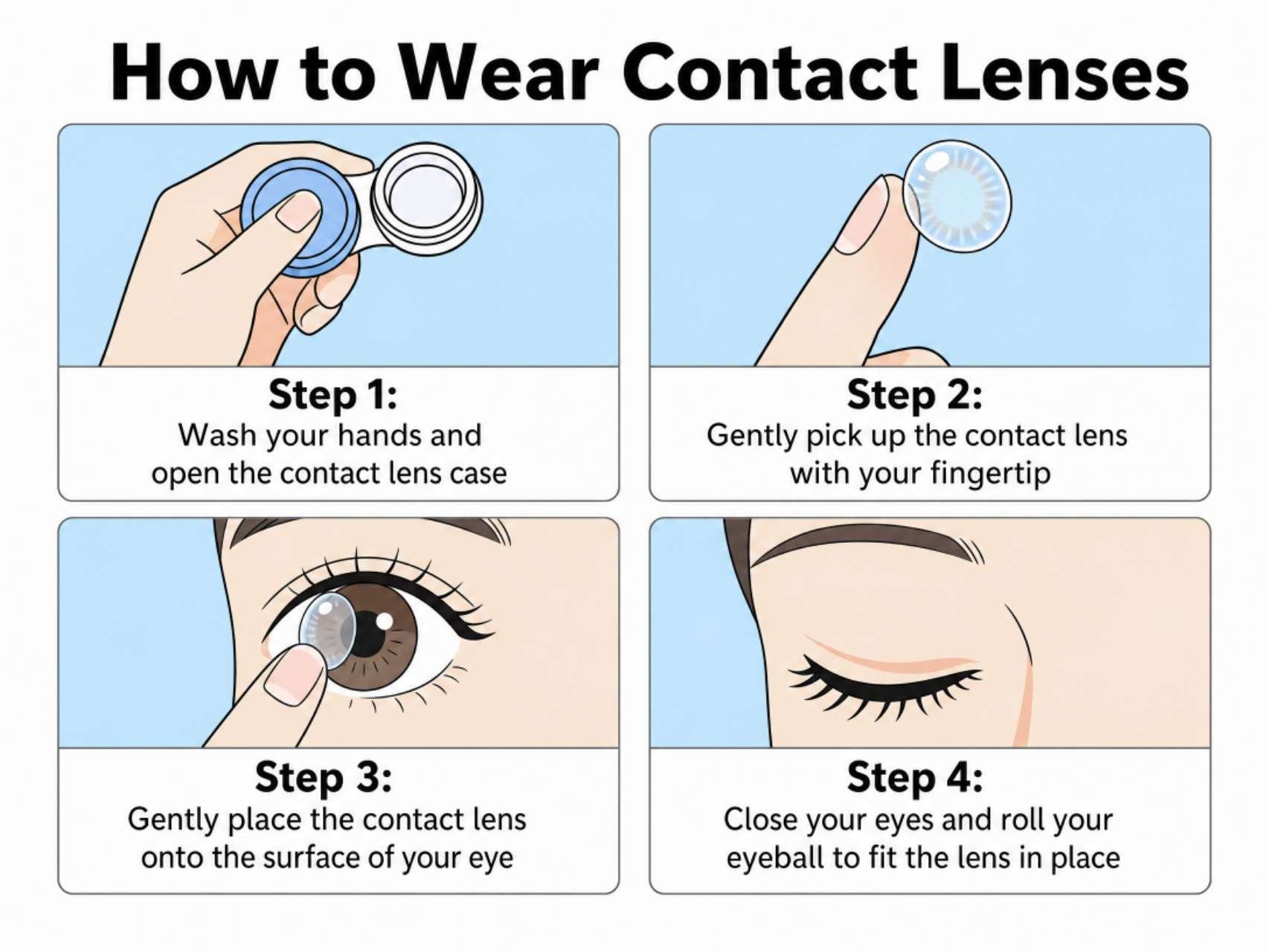
To put in a colored contact lens: place the lens bowl-side up on your index finger, hold your top and bottom eyelids open with your other fingers, look straight into the mirror, and gently press the lens onto the colored part of your eye. Blink slowly to settle it.
That's the textbook version. Here's the version that actually works for first-timers.
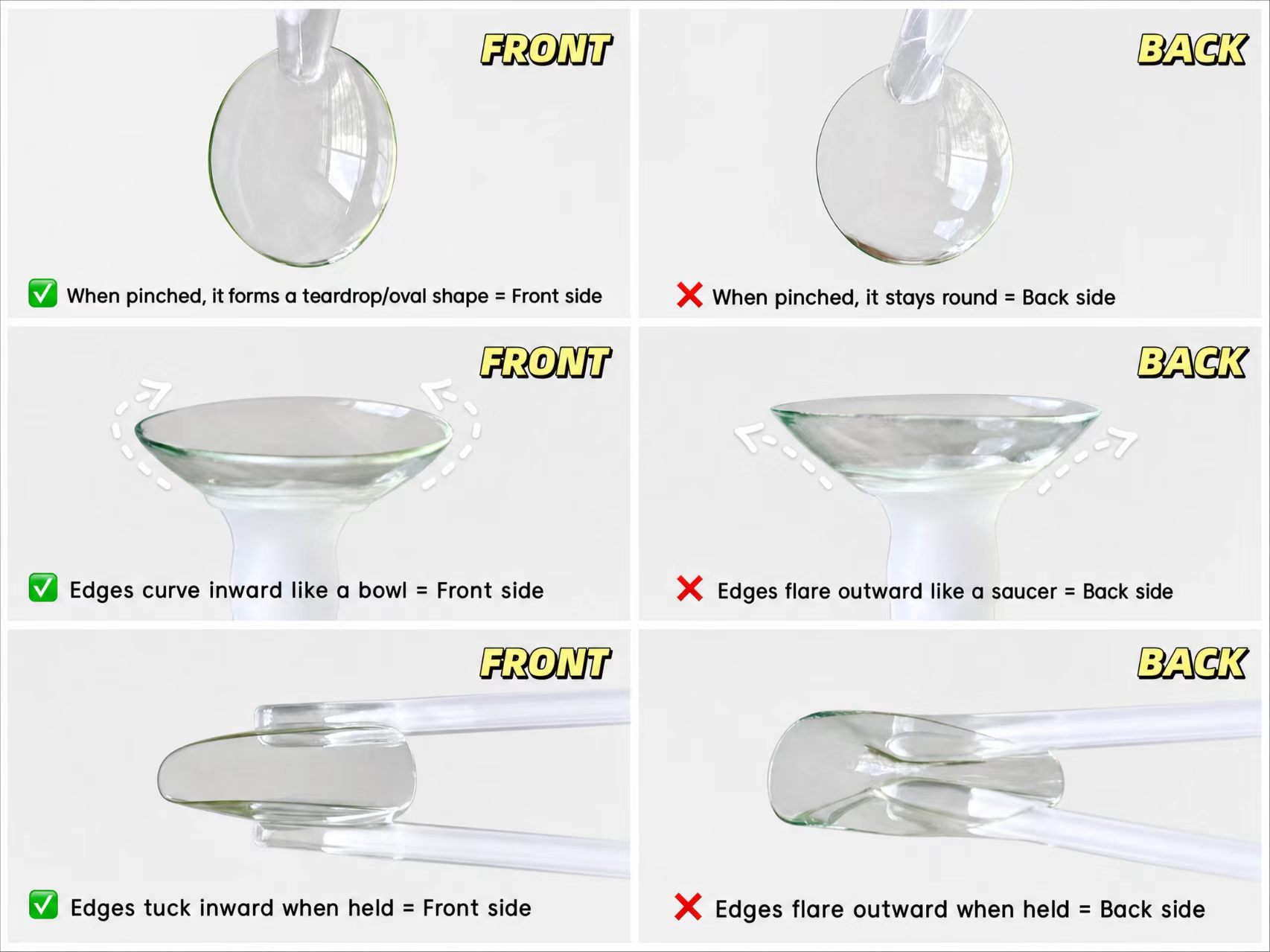
Step 1: Check it's not inside-out
Place the lens on your fingertip. Look at it from the side:
- Right way: shaped like a perfect bowl (or letter "U")
- Inside out: edges flare outward like a tiny taco
"If your contacts are inside out, you'll know—it's very painful and irritating, and they just won't sit right."
If you put one on inside-out, you'll feel it within seconds. Just take it out, flip it, and try again.
Step 2: Get your hands and face in position
- Lens on the pad of your dominant index finger (not the tip, not the nail)
- Use your other hand's middle finger to hold your upper eyelid—pull from the lashes, not just the skin
- Use the middle finger of your lens hand to pull down your lower lid
You want your eye to look as wide open as possible. If you can't keep it open, that's your real obstacle—not the lens.
Step 3: Look straight ahead and bring the lens in
Look directly into your own pupil in the mirror. Slowly bring the lens to your eye until it touches. The lens will stick to the moisture on your eye and basically pull itself off your finger.
Step 4: Blink slowly and let it settle
Don't squeeze your eye shut. Just close it slowly, roll your eye around a little, and blink a few times. The lens will center itself.
Pro Tips From People Who Finally Figured It Out
The standard steps work for some people. But if your eye keeps twitching or the lens won't land, try these tricks shared by real users who struggled at first:
① "The trick is just put it in the white part because your eyes won't twitch when you put it there."
Place the lens on the white of your eye first, then slide it onto your iris with a blink.
② "Don't look directly in the mirror, turn your face to the side, look at the mirror, and then put the lenses."
Side-eyeing your reflection stops your reflex to flinch toward your own pupil.
③ "Pull both upper and lower lids before makeup, so you don't have to worry about it messing up."
Always insert contacts before applying eye makeup. Powder, mascara flakes, and oils can otherwise get trapped under the lens.
④ "Try to touch your eyes 3–4 times a day for a couple of weeks to get used to the feeling."
If you're terrified of touching your eye, desensitize first. Tap your eyelid with a clean finger, then progress to the white of your eye. It sounds silly. It works. Is it normal for my vision to go blurry?
Yes—mild blurriness for the first 1–2 minutes is completely normal.
"Canon event: trying contacts for the first time, and your vision is blurry." (915 likes)
The lens needs a moment to settle, and your tears need to redistribute. Blink a few times. It should clear within a minute or two.
However, if you feel sharp pain or persistent discomfort, take it out and inspect it:
"I put it in the wrong way once, and it was SO painful."
Sharp pain, ≠ "getting used to it." Sharp pain = something's wrong (inside-out, a torn lens, or debris under the lens).
How Do You Take Out Colored Contacts Safely?
To take out a colored contact: wash and dry your hands, look up, pull down your lower eyelid, slide the lens down to the white of your eye with your fingertip, then gently pinch it between your thumb and index finger.
Taking them out scares people even more than putting them in. This comment got 2,621 likes on TikTok:
"But how does one take it out?"
And our personal favorite:
"Okay, how do u take it out? do u take your eyeball out, too?"
So let's address it directly.
You will not pull your eyeball out. Ever.
There is a thin membrane (the conjunctiva) that physically prevents anything from going behind your eyeball. The lens cannot get "lost in your head." It can only move:
- Onto the white of your eye
- Up under your upper eyelid
- Down under your lower eyelid
That's it. Three places. Always findable.
Standard removal steps
- Wash and dry your hands (dry fingers = better grip)
- Look upward
- Use your middle finger to pull your lower eyelid down
- Use your index fingertip to slide the lens down onto the white of your eye
- Gently pinch the lens between your thumb and index finger and lift it off
What if the lens won't come out?
This is the panic moment. Don't.
"I went to sleep, and I realized my left contact was still in. The contact is on my eye and visible, but I can't move it."
"The lens stuck to my eye."
A "stuck" lens almost always means your eye is dry, not that the lens is glued on. Try this:
- Stop and breathe. Aggressive poking makes it worse.
- Add 2–3 drops of contact-safe rewetting solution or preservative-free saline. Wait 60 seconds.
- Blink several times. The lens will float on the fresh moisture.
- Try again using the pinch method above.
If a lens slides under your upper eyelid, close your eye, gently massage the lid toward your nose, and it'll come back into view.
"Removing contact is only hard when you're scared of touching your eyes."
That's the whole secret. Most "stuck" lenses come out within 5 minutes once you stop panicking.
What If Something Goes Wrong? 8 Real First-Timer Problems (and How to Fix Each One)
This is the section every other guide skips. Here are the 8 problems first-timers actually run into, in the actual words of people who lived through them—and exactly what to do:
|
What Happened |
Real User Quote |
What to Do |
|
Lens "vanished" from your eye |
"They just seem to vanish from my eye." |
Don't panic. It's under your upper lid. Close your eye, look down, gently massage the upper lid toward your nose until it slides back into view. |
|
Sharp pain the second it touches your eye |
"I put it in the wrong way once and it was SO painful." |
Take it out immediately. 95% of the time it's inside-out. Flip it (taco test) and try again. |
|
Lens feels stuck and won't move |
"The lens stuck to my eye." |
Don't force it. Add rewetting drops, wait 1 minute, blink several times, then try the pinch method. |
|
Persistent blurriness even after blinking |
"Everything had this smeared Vaseline-like quality. I was convinced I was developing dry eye." |
This is often a solution compatibility issue—some preservatives don't play well with all lens materials. Try switching to a different multipurpose solution for a week. |
|
Lens ripped in your eye |
"It ripped in my eye." / "The contact ripped the very first time I tried to use them." |
Rinse your eye with sterile saline. Carefully remove any visible pieces using the pinch method. If you can't get all of it out, see an eye doctor the same day. |
|
Lens slid up under your eyelid |
"They went waaaaaaayyyy up under my eyelids." |
Same as —close your eye, gently massage in the direction of your nose. The lens cannot get lost. |
|
You forgot to soak the lens first |
"You're not supposed to put them straight from the pack." |
If it's already on your eye and feels uncomfortable, take it out. Soak in fresh multipurpose solution for 6+ hours before retrying. |
|
You rinsed it with tap water |
"PLEASE DO NOT USE WATER. You can get blind of using water, please do not." |
Throw the lens away. Tap water contains Acanthamoeba, a microorganism that can cause permanent vision loss. This is not an exaggeration—the CDC has issued warnings about this for years. |
The pattern in all 8 cases: the problem is almost never your eye. It's prep, technique, or the lens itself. Slow down, troubleshoot, and 7 out of 8 of these fix themselves in under 5 minutes.
4 Safety Rules You Genuinely Cannot Break
Everything else in this guide has wiggle room. These four don't.
Never rinse or store contacts in water.
Not tap water, not bottled water, not shower water. Tap water contains Acanthamoeba, a microorganism that can infect your cornea and cause permanent blindness. This is the single most important rule of contact lens wear.
Never sleep in colored contacts.
Even if your lenses are marketed as "extended wear," colored contacts in particular reduce oxygen flow to your cornea. Sleeping in them dramatically raises your risk of corneal ulcers and infection.
"Girl, these are the only set of eyes you get. Please don't keep your contacts in overnight."
"I got 3 eye infections from it "
Never share contacts—even for one TikTok.
You're sharing every microorganism that lives on your friend's eye. No filter is worth that.
Never overwear, especially on day one.
Cap your first day at 4 hours. Add 1–2 hours per day, up to a maximum of 8 hours per wear. Your eyes need to acclimate.
"Y'all PLEASE go read up on 'contact lens overwear syndrome.'"
How Do You Choose Safe Colored Contacts as a Beginner?
Choose colored contacts that require a verifiable prescription, are made from biocompatible materials, and come with clear instructions and beginner-friendly tools (like an applicator and individual cases).
The lens you choose matters as much as how you put it in. A few things to look for:
- Sold as medical devices, not "costume accessories." Lenses sold on random marketplaces that don't require a prescription are a red flag.
- Material disclosed. HEMA-based lenses are common and generally safe, but you should know what's in them.
- Comes with tools and instructions. First-timers do dramatically better with a kit that includes an applicator wand and a clear step-by-step guide.
Here's what real beginners said about lenses that worked for them:
"As someone who has never worn contacts before, these were of such amazing quality and so easy to put in!"
"First time using contacts and these were surprisingly easy to put in, and they are comfortable enough to wear for hours."
"Very beginner-friendly!! The tools are a great help for beginners."
"For someone with sensitive eyes, EYEVOS contacts are lightweight, thin, and comfy."
FAQ · The Questions Every First-Timer Asks
Does it hurt to put in colored contacts for the first time?
No, it shouldn't hurt. You may feel mild awareness or a slight scratchy sensation for the first few minutes, but actual pain means something is wrong—usually the lens is inside-out, torn, or has debris on it. Take it out and check.
How long does it take to get used to wearing colored contacts?
Most first-timers adapt within 3–7 days of consistent wear. Start with 2–4 hours on day one, then add 1–2 hours per day. By the end of the first week, most people forget they're wearing them.
Can colored contacts get stuck behind my eye?
No. It's physically impossible. The conjunctiva—a thin membrane connecting your eyelid to your eyeball—seals off the area behind your eye. A "lost" lens is always either on the white of your eye or tucked under an eyelid.
How long should I soak colored contacts before wearing them for the first time?
At least 6 hours, ideally overnight. Colored contacts ship in a packaging solution that isn't meant for direct eye contact. Soaking them in a fresh multipurpose solution neutralizes that packaging fluid and softens the lens.
Are colored contacts safe for sensitive eyes?
They can be, if you choose lenses with high water content, thin profiles, and a material your eye tolerates. Many sensitive-eyed wearers do well with lenses designed for daily comfort. Always start with short wear times and pay attention to how your eyes feel.
Can I wear colored contacts if I have astigmatism?
Only if they're toric lenses prescribed for your specific astigmatism. Regular colored contacts won't sit correctly on an astigmatic eye, and you'll experience blurred or doubled vision. Get a prescription before buying.
What should I do if my colored contacts feel uncomfortable after a few hours?
Take them out. Discomfort that starts hours into wear usually means dryness, overwear, or solution sensitivity. Use rewetting drops designed for contact lenses, give your eyes a break, and reassess. If it keeps happening, consult an eye care professional.
A Final Word
If you're reading this for the first time, please know it's okay to feel nervous. It's okay to take an hour. It's okay to put the lens down, walk away, and try again tomorrow.
You're learning a skill that millions of people have learned before you—including the girl who cried in LensCrafters and the guy who took two hours to get one in. They all figured it out. So will you.
Take it slow. Be gentle with your eyes, and with yourself.
You've got this.
Learn More
If you want a deeper breakdown of beginner-friendly options and how to spot risky ones, we've written two companion guides:
- How to Put In Colored Contacts for Beginners
- Are AliExpress and Shein Colored Contacts Worth the Risk?
- The Best Doll Makeup Looks for 2026: 6 Dolly Lenses & How to Wear Them
- What Colored Contacts Should You Wear for Ariana Grande Concert Makeup?
References
The medical and safety information in this guide is based on guidance from the following authoritative sources:
1. U.S. Food and Drug Administration (FDA) – Decorative Contact Lenses for Halloween and More
2. American Academy of Ophthalmology (AAO) – Costume Contact Lenses Pose Serious Risks to Sight
3. American Academy of Ophthalmology (AAO) – Eye Infections From Contact Lenses
4. Centers for Disease Control and Prevention (CDC) – About Contact Lenses
5. American Optometric Association (AOA) – Contact Lens Care
Disclaimer
This guide is intended for educational purposes and does not replace professional medical advice. If you experience persistent pain, redness, or vision changes while wearing contact lenses, remove them immediately and consult a licensed eye care professional.
Comment